
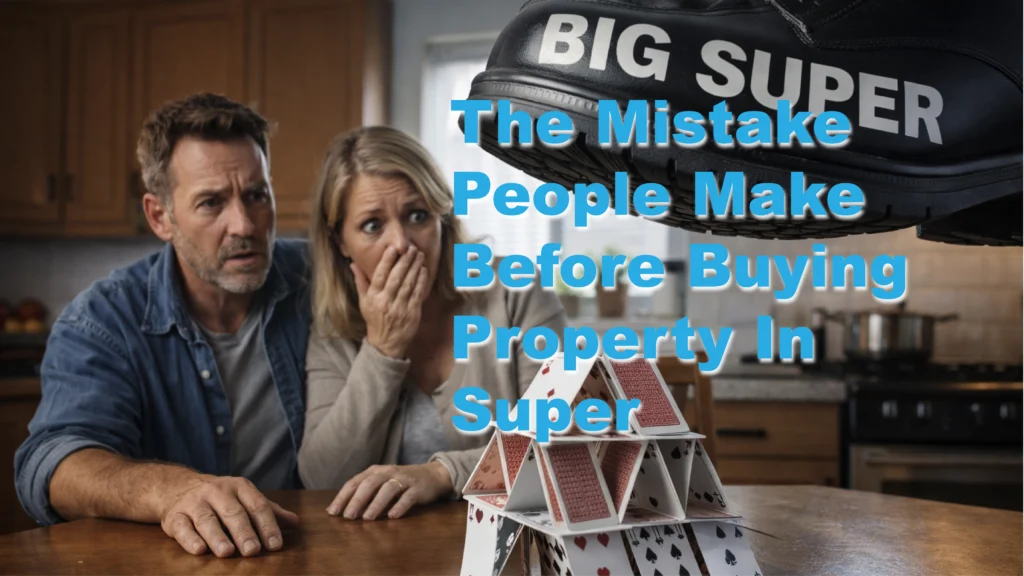
For years, Australians have been told the same thing.
Buying property through your super is risky.
Complicated.
Best left to professionals.
That message gets repeated so often it starts to feel like gravity. Unquestionable. Just “how it is”. The funny thing is, no one ever really explains why it’s supposedly so dangerous. You’re just meant to accept it.
So here’s the question most people never stop to ask:
Who actually benefits when you believe your super is too complicated to touch?
Big Super loves complexity. You pay for it.
We all understand the idea of Big industries.
Big Pharma.
Big Tech.
Big Banks.
Different sectors, same pattern: scale first, individuals second. Super is no different. Australia’s retirement system is dominated by a handful of enormous institutions managing trillions of dollars. Let’s call it what it is:
Big Super.
Big Super isn’t evil.
But it is very comfortable.
It collects fees whether markets rise, fall, or go sideways.
It thrives on scale. And it relies on one thing above all else:
Most people not asking too many questions.
Complexity helps with that. If super feels too technical, too risky, too “expert-only”, most people do exactly what the system expects them to do, nothing.
And Big Super rolls on.
Your super isn’t really your super while you’re disengaged
Here’s the uncomfortable part.
As long as your super sits inside Big Super and you don’t engage with how it’s structured, it isn’t really your super in any meaningful sense.
It’s your name on the statement. Your retirement on the line. But the decisions? The sequencing? The risk exposure? That’s all being shaped by a system designed for averages, not individuals.
Your super only becomes your super when you actually take responsibility for how it’s put together.
Fear is a very useful tool — just not for you
When SMSF property fails, the headlines are loud.
Trustees getting it wrong.
Compliance breaches.
Frozen funds.
Regulators have warned for years about poor advice, conflicted incentives, and people not understanding borrowing arrangements properly (ASIC, 2019; ATO, 2023). That’s all true. But notice what the takeaway always seems to be:
“See? Property inside super is dangerous.”
That framing is convenient. It keeps the focus on the asset instead of the process. And it quietly reinforces the idea that stepping outside Big Super’s default settings is reckless behaviour.
The thing no one really wants to say
Here’s the part that makes people uncomfortable:
Property itself isn’t where most SMSF strategies fail.
They fail earlier. Much earlier. They fail because decisions are made in the wrong order. Most trustees who end up in trouble didn’t misunderstand the law.
They didn’t wake up trying to break rules.
They misunderstood the sequence.
And that misunderstanding is incredibly common.
How people actually get trapped
It usually goes something like this:
- Someone starts looking into property inside super
- A deal appears early, sometimes very early
- Momentum builds
- Structure and sequencing get dealt with later
By the time proper advice is sought, the big decisions are already locked in.
Borrowing terms.
Ownership structure.
Timing.
At that point, advisers aren’t designing a strategy. They’re trying to manage the damage. That’s not recklessness.
That’s what happens when complexity delays clarity.
Big Super doesn’t need to stop you — it just needs you to hesitate
Australia’s SMSF rules aren’t designed to stop people investing in property. The framework around limited recourse borrowing, asset use, and related-party rules is well established and publicly available (ATO, 2024). What most people are missing isn’t permission.
It’s coordination.
SMSF property sits at the intersection of:
- trust law
- tax law
- lending policy
- property law
- ongoing compliance
No single professional owns the whole sequence. And when no one owns the sequence, guess who ends up carrying the risk?
You do.
Big Super can afford inefficiency.
You can’t.
Where risk really lives
Risk isn’t where you’ve been trained to look for it.
It’s not property versus shares.
It’s not growth versus income.
It’s not even markets moving up and down.
Risk lives in the gaps between decisions.
That’s exactly where regulators and inquiries keep finding problems — not because people were careless, but because responsibility was fragmented (Royal Commission, 2019).
Everyone involved might have done their job.
But no one owned the outcome.
Ask a better question
So the question isn’t:
“Is property inside super risky?”
The better question is:
“Has Big Super’s complexity narrative stopped me from understanding the order in which the decisions that matter actually need to be made?”
Because once the order is wrong, even a sensible investment can become a long-term headache. And once the order is right, risk becomes something you can actually see — and manage.
Where Super Equity Link comes in
Super Equity Link exists for people who are tired of being told:
“It’s too complicated. Just leave it to the system.”
We don’t pretend this is simple.
We don’t bypass rules.
And we don’t talk in riddles.
We exist to help people step out of Big Super thinking and start taking responsibility for Your Super, by making sure the decisions that matter most happen in the right order, with full visibility of the consequences.
Because at the end of the day, your super only becomes your super when you stop outsourcing the thinking.
REFERENCES
Australian Securities and Investments Commission (ASIC). (2019). SMSF advice: Improving quality of advice.
Australian Taxation Office (ATO). (2023). Self-managed super funds: Investment risks.
Australian Taxation Office (ATO). (2024). Limited recourse borrowing arrangements.
Royal Commission into Misconduct in the Banking, Superannuation and Financial Services Industry. (2019). Final Report.