
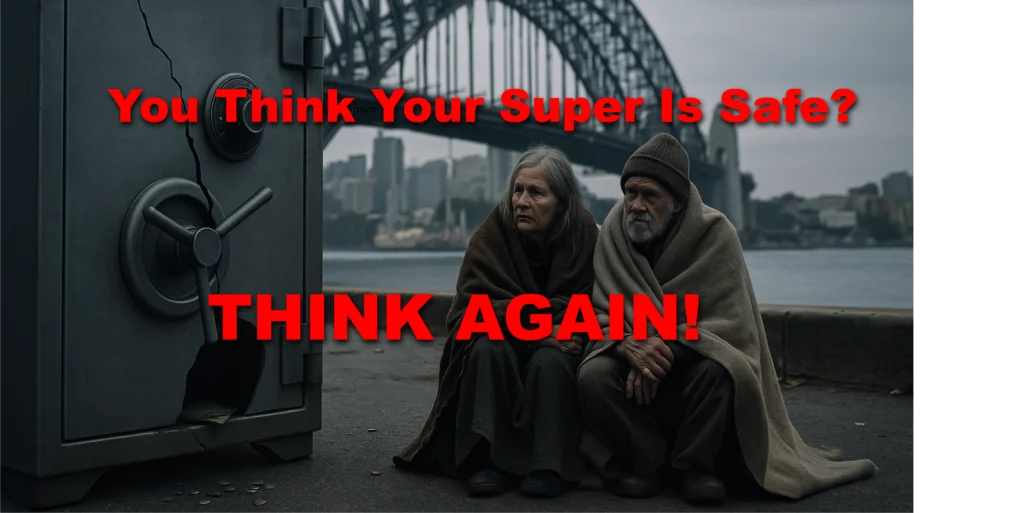
Your Super Isn’t As Safe As You Think — And The Evidence Is Stacking Up
Most people in Australia walk around with this unconscious belief that their superannuation is basically a steel vault; locked, protected, “professionally managed,” and guaranteed to be there when they retire. But if you scratch beneath the surface, the story gets uncomfortable very quickly.
And I’m saying this not to scare anyone — but because the facts are the facts.
Over the past few years, major investigations, collapses, and regulatory reports have exposed something most of us were never told,
Your super is only as safe as the people managing it — and sometimes, that’s not safe at all.
When Super Funds Fail, Members Pay the Price
Let’s start with a very real example.
In 2024–2025, the collapse of the Shield Master Fund and the First Guardian Master Fund left more than 12,000 Australians staring at a combined loss of around $1.2 billion of their retirement savings (SuperConsumers, 2025; The Guardian, 2025).
Yes. Billions, with a “b.”
ASIC didn’t mince words either. When announcing action against advisers who pushed people into these funds, ASIC stated,
“No competent financial adviser could have recommended Australians invest large amounts of their superannuation in these funds.” (ASIC, 2025)
That’s the regulator basically saying,
People were led into super disasters they never saw coming.
And if this happened in any other financial product, Australians would be rioting. But because it happened “inside super,” most people still assume it’s a one-off.
It’s not.
It’s part of a much bigger pattern and the latest evidence proves it.
New 2025 Findings: Poor-Performing Retirement Products Are Everywhere
A brand-new analysis from Super Consumers Australia (reported by ABC News on 19 November 2025) uncovered something even more alarming.
The difference between the best and worst retirement-phase super options can be $57,000 to $205,000 over a typical retirement. (ABC News, 2025)
That’s not a rounding error.
That’s the difference between,
retiring comfortably, or
running out of money early.
But here’s the real kicker…
The government’s performance test DOES NOT APPLY to retirement products.
So even if a product has been failing for years, it can still be sold to retirees, right when they are most vulnerable.
ABC reported that of 140 accumulation options that failed the performance test since 2023, 128 (91%) were also offered as retirement products.
Let that sink in.
Funds that repeatedly failed in your working years can be quietly handed to you again when you retire — without any warning label.
This isn’t a conspiracy.
It’s a visibility problem.
Risk Isn’t Just Market Fluctuation — It’s Structural
When we talk about “risk in super,” most people think it’s just about market ups and downs.
But the real risks go deeper.
1. Governance and trustee failure
The Conexus Institute summed it up in 2025,
“Super funds expose their members to economic and market risk in order to seek higher expected returns, with the associated risks seemingly underappreciated.” (The Conexus Institute, 2025)
Translation?
Funds often take risks you don’t know about and you wear the consequences.
2. Liquidity shocks and what 2020 revealed
During COVID, even the largest “safe” funds were caught off guard.
The RBA’s 2021 Financial Stability Review highlighted:
members switching rapidly into cash,
forced asset sell-downs,
liquidity shortfalls,
margin calls,
pressure from early withdrawals.
The RBA stated plainly,
2020 revealed “significant liquidity challenges facing superannuation funds.” (RBA, 2021)
So if the giants struggled, what does that tell you?
3. High-concentration risk in SMSFs
For SMSF members — especially smaller ones — the Council of Financial Regulators warned,
Some retirement savings may face “significant risk” where there is high asset concentration or personal guarantees. (CFR & ATO, 2022)
Again, this is not fringe commentary.
This is Australia’s top financial regulator talking.
Super Isn’t Risk-Free — It’s Risk You Can’t See
People think super is safe because it feels invisible and managed behind closed doors.
But invisibility is not safety.
Your money is invested in assets you don’t choose, by people you never meet, using strategies you never agreed to, exposed to risks you’re never told about.
If something goes wrong — like it did for those 12,000 Australians — you carry the loss.
NOT the fund manager.
NOT the adviser.
You.
So What’s the Alternative? Take Control of Your Future.
This doesn’t mean everyone should abandon super or panic.
It means this,
Leaving your entire retirement to strangers who take risks on your behalf is not a strategy — it’s hope.
And hope is not a retirement plan.
This is why more Australians are choosing direct property inside their super:
Because property is;
tangible
visible
understandable
slow-moving and stable
insulated from hidden trustees and opaque committees
And through structured guidance, like what we’re building with Super Equity Link, people can finally invest their super with clarity instead of blind trust.
You can literally stand in front of the thing your retirement is built on.
Try doing that with a derivatives exposure buried in a PDS.
Your Future Deserves More Than Blind Trust
When you add up the evidence — fund collapses, liquidity shocks, trustee failures, poor oversight in retirement products, and now the $205,000 performance gap uncovered in 2025 — the old belief “my super is safe” starts to look like a myth.
Here’s the truth:
Your super is not automatically safe.
It’s only as safe as the decisions being made for you.
And if those decisions are made without your input, visibility, or control…
That’s not security.
That’s outsourcing your future.
Whether you choose Super Equity Link or any other guided SMSF strategy, the point is simple:
Take control.
Know what you own.
Build something real.
Your retirement deserves more than blind trust.
References
ABC News. (2025, November 19). Super Consumers warns retirees could lose up to $200,000 by picking poor-performing retirement products. Australian Broadcasting Corporation. https://www.abc.net.au/news/2025-11-19/super-consumers-performance-warning-retirees-after-retirement/106021954
Actuaries Institute. (n.d.). Uplifting superannuation risk-based capital management. https://www.actuaries.asn.au/research-analysis/thought-leadership/uplifting-superannuation-risk-based-capital-management
ASIC. (2025). Shield Master Fund: Enforcement activities. Australian Securities and Investments Commission. https://www.asic.gov.au/about-asic/asic-investigations-and-enforcement/enforcement-activities/shield-master-fund
Council of Financial Regulators, & Australian Taxation Office. (2022). Leverage and risk in the superannuation system: Report to government. https://www.cfr.gov.au/publications/policy-statements-and-other-reports/2022/report-on-leverage-and-risk-in-the-superannuation-system
Reserve Bank of Australia. (2021). Financial stability review: Box C—Liquidity challenges facing superannuation funds. https://www.rba.gov.au/publications/fsr/2021/apr/box-c
Super Consumers Australia. (2025, September 12). What you need to know about Shield and First Guardian Master Funds. https://superconsumers.com.au/journalism/what-you-need-to-know-about-shield-and-first-guardian-master-funds
The Conexus Institute. (2025). Systemic impacts of “big super”: Summary version. https://theconexusinstitute.org.au/wp-content/uploads/2025/02/Systemic-impacts-of-big-super-Summary-Version-Final.pdf
The Guardian. (2025, July 24). Investment fund collapse linked to superannuation platforms. https://www.theguardian.com